


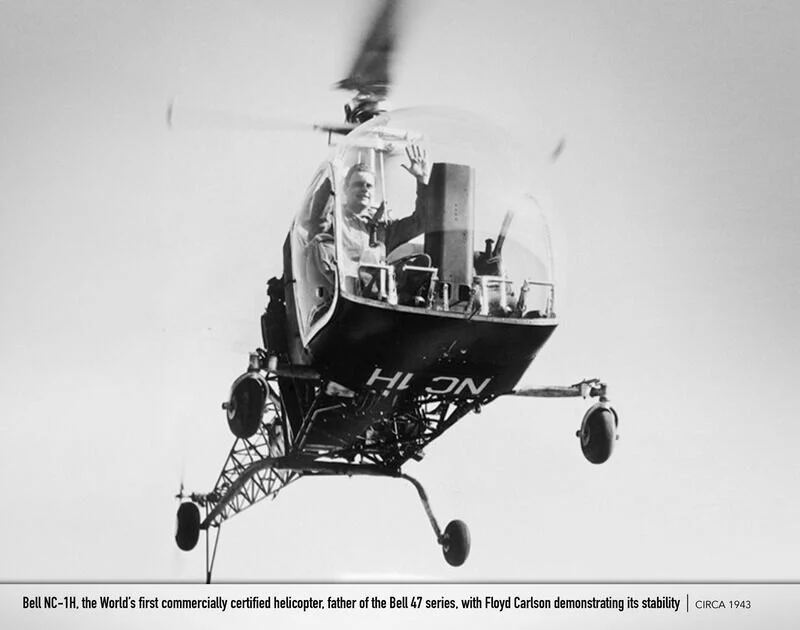
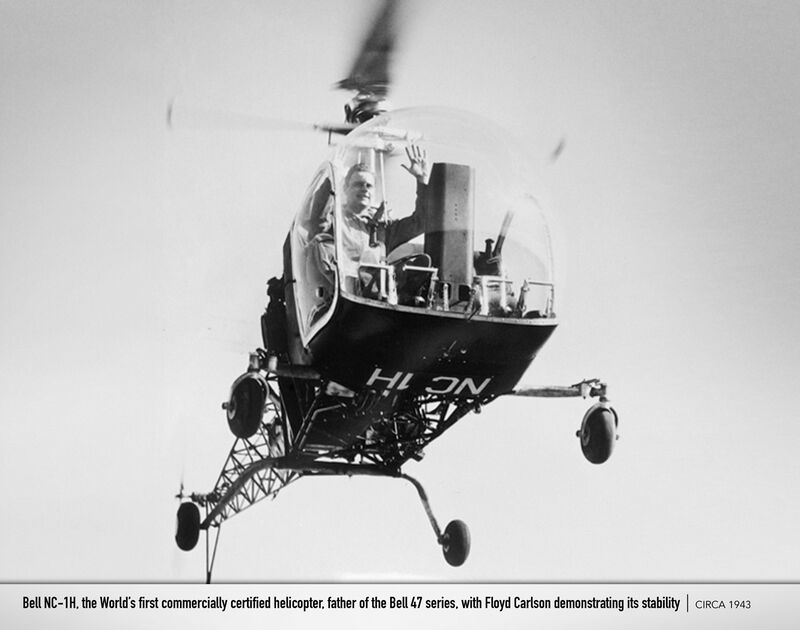
Before Bell delivered the first certified helicopter, the future of vertical flight was proven with an egg. While pilots and engineers struggled with the uncertainties of rotorcraft technology, a single demonstration showed how physics could not just make it possible, but safe. This became the spark that led Bell into pioneering a new era of aviation.
Larry Bell’s lifelong passion for aviation led him to start the Bell Aircraft Corporation, now Bell Textron Inc., over 90 years ago. His company quickly became a leader in fixed-wing aircraft production, but he was always looking toward the future.
The concept of vertical flight was still unproven, and many in the industry remained skeptical. But Larry Bell recognized its potential, and an opportunity presented itself when he met an independent inventor who had been experimenting with rotorcraft technology.
Larry Bell took a chance, and hired the inventor, Aurthur Young, giving him the support needed to refine his designs. Young brought a unique perspective to helicopter design – unlike many engineers of his time, he focused on stability and control. His work led to Larry Bell’s first helicopter, the Model 30, which had a single main rotor, a tail rotor for stability, and a stabilizer bar – a configuration that would become the industry standard.
Young’s engineering laid the foundation, but proving the aircraft in flight required an experienced test pilot.
Floyd Carlson, Larry Bell’s chief test pilot, had spent his career evaluating new aircraft. However, flying a rotorcraft required an entirely different skill set from fixed-wing operations.
In September 1942, Carlson climbed into the cockpit of the Bell Model 30 for its maiden flight. With careful control, he lifted the aircraft off the ground, hovered, and made small adjustments to stabilize it. Larry Bell watched from the ground as his company entered a new era.
While the flight proved the helicopter’s ability to take off and hover, Bell needed to know it could land safely in emergency situations, even if its engine failed.
Carlson presented a simple demonstration, whereby he dropped an egg straight to the ground and it shattered. Next, he threw another egg into the air and caught it in a smooth, sweeping motion, allowing it to land safely. “That’s autorotation, and that is what we need to achieve,” he explained. Carlson’s demonstration, and the technology used in the platform’s build that ensured its capability, convinced Bell that helicopters could be safe and practical for widespread use.
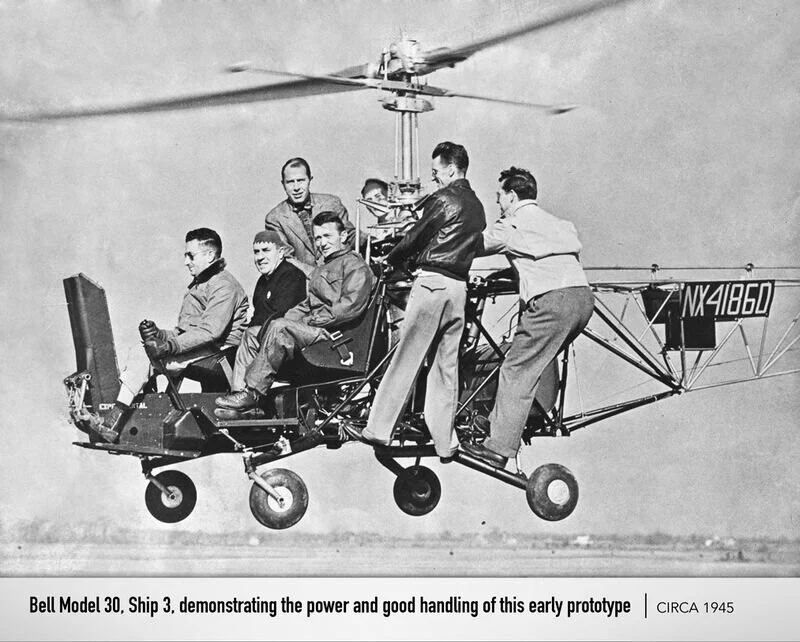
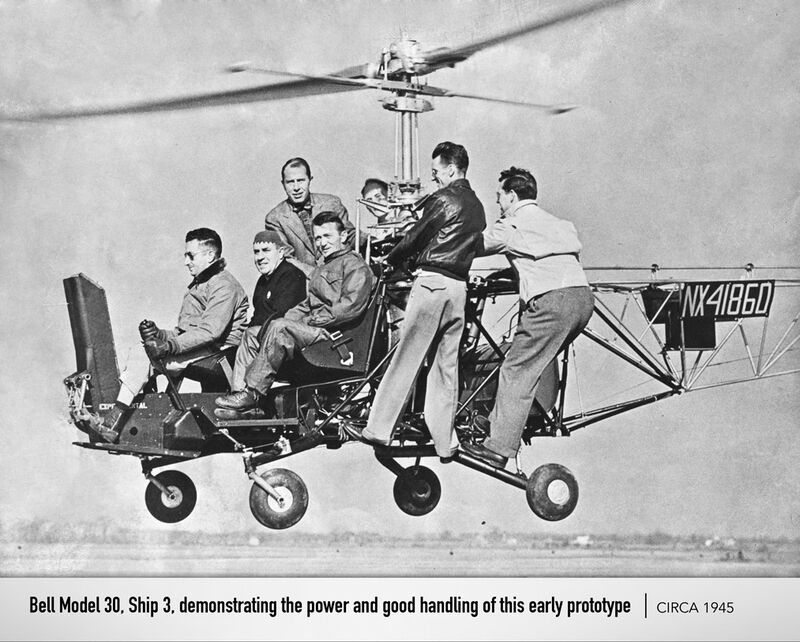
The Bell Model 30 served as a proof of concept, leading to the Bell 47 – the world’s first certified commercial helicopter. Introduced in 1946, it became an aviation icon, widely used for both commercial and military operations.
The egg experiment led to Bell’s current training practices. The Floyd Carlson Airfield also offers full touchdown autorotation – one of the many key differentiators of Bell’s customer training experience. Over the past five years, more than 230,000 customers have come from 131 countries to train at the state-of-the-art facility and learn from Bell’s expert instructors.
What had begun as an experimental aircraft, evolved into a global industry, with Bell at the forefront. Each of the 35,000+ Bell aircraft produced to date, traces its origins back to the egg in 1942 – when the Bell Aircraft Corporation solved vertical flight technology and never looked back.
Read more about Bell’s training and Floyd Carlson’s legacy.